
Article: The Injury Risk Your Athletes Can't Feel Coming
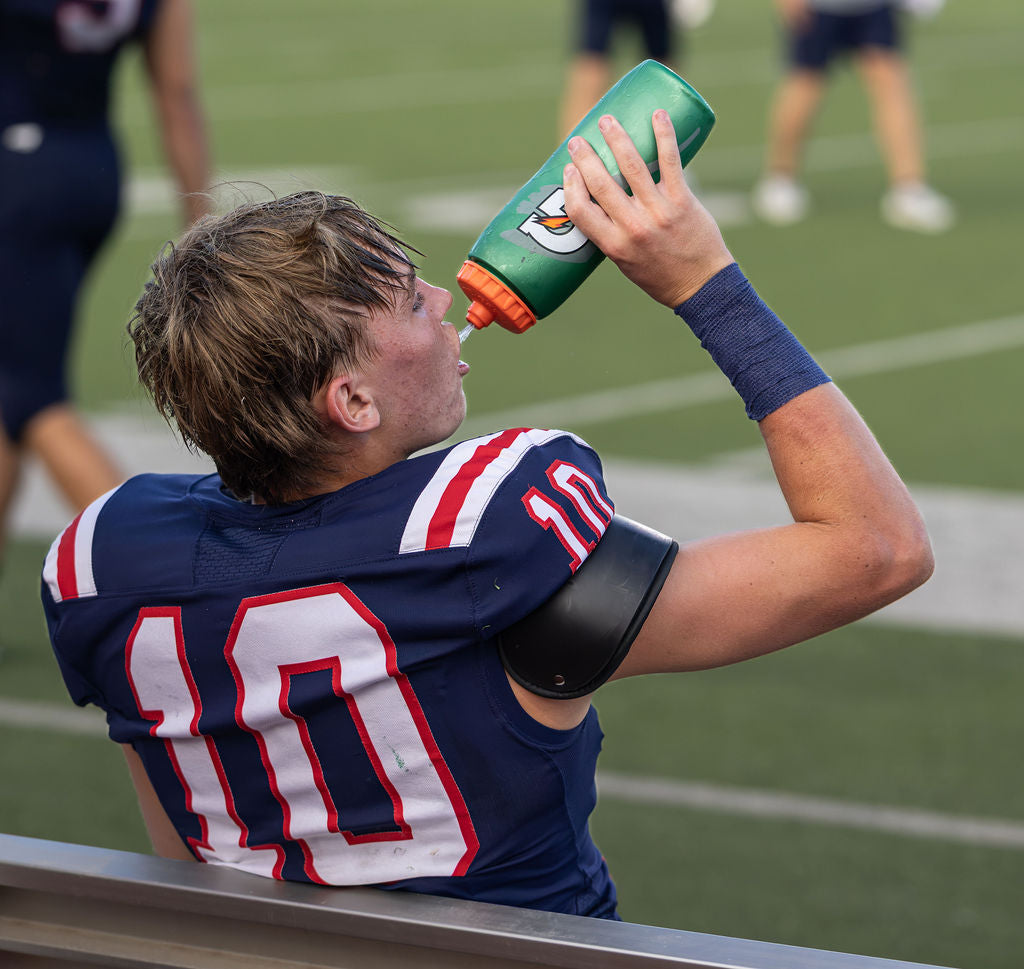
The Injury Risk Your Athletes Can't Feel Coming
Most coaches think about heat and performance. Fewer think about heat and injury. But the research connecting the two is direct — and it changes how you think about what a hot practice is actually doing to your roster.
The problem isn't dehydration. It's the brain.
When core temperature climbs above roughly 102°F, something specific happens: the brain starts pulling back the signal it sends to muscles. Voluntary activation drops. Max strength drops. This isn't fatigue from exertion — researchers demonstrated it by passively heating subjects with no exercise at all. The brain-to-muscle signal fell 11%. Strength dropped 13%.
Here's the part that catches most people off guard: when researchers cooled the skin rapidly, athletes felt better immediately. Heart rate settled. But strength didn't come back. Neural drive didn't recover. The only thing that restored strength was restoring core temperature. Feeling better and being better are two different things.
Motor control goes before cognitive function does
A meta-analysis of 49 studies and 528 effect sizes found that heat degrades motor skills — reaction time, coordination, tracking — three to five times faster than it degrades thinking. And it compounds. After two to three hours of exposure, complex motor performance is roughly five times worse than it was in hour one.
This matters because non-contact soft-tissue injuries — hamstring pulls, ankle rolls, ACL events — are motor control failures. The landing is slightly off. The cut is slightly late. The deceleration is a frame slower than it needed to be. Heat is quietly eroding the precision that prevents those failures, and it's doing it faster than your athletes can feel it.
The environment is not equal across your roster
In professional football, research confirmed what the mechanism predicts: in warm-climate leagues where WBGT reaches physiologically meaningful levels, higher temperatures were associated with more injuries. In cold-climate leagues, no signal. The temperature has to be high enough to move core temp — and once it does, the injury curve moves with it.
What the team-level data can't show you is which athlete on your roster crosses the threshold first. Individual ceiling differences of 1.8–3.6°F mean one player can be in trouble while the player next to them is fine. A single team-wide cutoff misses the one who fails first.
What this means in practice
You can't cool the skin and call it done. You can't wait for visible signs — by the time an athlete looks overheated, the neuromuscular decline is already well underway. And you can't use yesterday's practice as a baseline for today's risk, because the deficits carry over.
Read the full science behind heat strain and soft-tissue injury risk →
References: Morrison et al., Eur J Appl Physiol 2004 (PMID 15015001) · Nybo & Nielsen, J Appl Physiol 2001 (PMID 11509498) · Hancock et al., Human Factors 2007 (PMID 17915603) · Schwarz et al., Environ Epidemiol 2025 (PMID 39850845)

